
Chris Wright Addresses Venezuela, Climate Alarmism, And America Doing Big Things Again

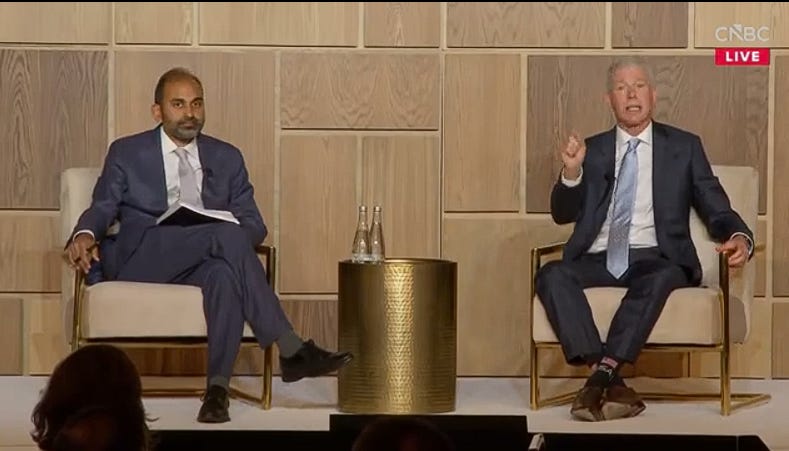
Great interview by Energy Secretary Chris Wright at a Goldman Sachs event in New York City this morning. Wright addresses myriad topics in this 42-minute clip. A transcript follows for all you Boomers who still insist on reading stuff. LOL.
Transcript:
Host: [00:00:06] Standing room only. Thank you so much. I’m Neil Maida. I am the head of Natural Resources Equity Research for Goldman Sachs in North America. I have the great pleasure of introducing someone who is just about to come onto the stage, Secretary Chris Wright, the U.S. Secretary of Energy. Chris is someone we know very well here at Goldman Sach’s and have had the pleasure of having at this conference for many years as a CEO. This is our first time having him as the Secretary of energy and he really needs no introduction but just to level set. Chris is a self-described energy nerd, turned entrepreneur. Many of us know him from his contributions at Liberty Energy in the oil and gas industry, but he spent time in nuclear, solar, geothermal. He completed an undergraduate degree in mechanical engineering at MIT, a graduate work in electrical engineering at UC Berkeley and MIT. He founded Pinnacle Technologies, which actually created the hydraulic fracture mapping industry. He was chairman of Stroud, an early shale gas producer, which many of us remember was sold to range. And of course, we know Chris from Liberty Energy, where he helped to enable the Shell Revolution, and where he was also active in the work around small modular reactors. One last plug for Chris, his book, Bettering Human Lives, still lives as one of the most data-intensive and complex analyzes around the trade-offs of energy, climate, poverty, and prosperity. At the core of it is a very simple tagline. Energy matters, everyone desires and deserves more of it, and the opportunities it unleashes. He hails from Colorado, he’s an avid Doorman, he’s environmentalist, which a lot of people don’t know about him, something I’m sure he’s gonna touch upon today. So Chris, come onto the stage, it’s an honor. Thank you for being here. Thank you, thank you, and thank you. Chris, it means so much. There’s so much that you’re here. There’s much happening across the energy landscape. Congratulations on the new role. Let’s touch on the issue that everyone’s focused on today, which is Venezuela, and then we’re gonna step back and we’re going to talk about a lot of other things, including AI, nuclear, the future for the oil and gas industry. But really, I want to give you a platform to talk the current situation in Venezuela from an energy perspective and the path to restoring production in the country. [00:02:22][135.9]
Secretary Wright: [00:02:23] Thanks Neil, thanks everyone for being here. I love this industry, the energy industry makes the world go round. So we lost sight of that I think for 10 years or so. But Venezuela, everyone in here that runs an oil and gas company employs Venezuelans. Why is that? Because a quarter of the country was forced to flee and leave the conditions. We’ve all watched for 25 years as this went from a prosperous American ally, successful society, one of the shining stars of Latin America, and it’s just had a 25-year horrific decline, not only for its own people, but think of the government there today. There’s a 25-page, unsealed indictment about the narco-terrorist behavior of the Venezuelan government. Right? They run drugs, guns, and people, kidnapping American citizens. Massively disruptive for the Western Hemisphere and for the citizens of the United States. Everyone’s bemoaned it, talked about it, complained about it. But all the action against Venezuela so far has been paper tigers. President Trump is different. He’s not a paper tiger. He’s a tiger. He wants to change the situation in Venezuela. There was a lot of negotiation, a lot of offers, a lots of ways to do this in a simpler fashion, a more voluntary fashion. They were not taken. So what happened was an incredibly brilliant military operation done for the drug enforcement agency to arrest Maduro and his wife, extradite them from the country, and take them into US custody. We want to change the game in Venezuela, fix the country so it’s a productive member of the Western Hemisphere, so it is an ally of the United States and a major supplier of oil to the world. But the old ways weren’t working. This started, as everyone knows, with an oil blockade, right? They get money from two things, selling oil and selling drugs. And we ultimately want to cut off completely the selling drugs and grow the selling oil. But in the short term, there was a blockade. Major cash flow source, Pince Venezuela. We get out the heads of this criminal gang. And now we have a different arrangement where instead of the oil being blockaded as it is right now, we’re going to let the market, let the oil flow, sell that market to United States refineries and to around the world to bring better oil supplies, but have those sales done by the U.S. Government and deposited into accounts controlled by the US government. And then from there, those funds can flow back into Venezuela to benefit the Venezuelan But we need to have that leverage and that control of those oil sales to drive the changes that simply must happen in Venezuela. So it’s no longer a drug threat, a kidnapping threat, a gun-running threat. An enabler of our adversaries in our hemisphere, Venezuela has been a train wreck for the United States and the American people. And under President Trump leadership, we’re all in to change that and restore it to a much better situation that not only will benefit the American People, the American economy, and global energy markets, but of course, it’ll also massively benefit the people of Venezuela. Eight million Venezuelans fled. Let’s make a society people wanna go back to invest in and grow. [00:05:50][207.7]
Host: [00:05:52] Chris, the President recently announced your role in executing the plan to turn over between 30 to 50 million barrels of sanctioned oil to the U.S. We learned about that as an investment community yesterday. What can you share about the recent announcement and talk about the plans to execute this? Yeah, so. [00:06:10][18.0]
Secretary Wright: [00:06:10] Look, I’m working directly in cooperation with the Venezuelans, and we are going to – this is the crude that’s backed up in onshore storage and that’s in offshore floating storage. We’re just going to get that crude moving again and sell it, just like we did in our businesses. We’re going to market the crude coming out of Venezuela first, this backed up stored oil, and then indefinitely going forward, we will sell the production that comes out of Venezuela into the marketplace. We will have U.S. As the supplier of diluent that’s got to get down there to enable that production. We’re going to have that flowing again. And as we make progress with the government, you know, we’ll enable the importing of parts and equipment and services to kind of prevent the industry from collapsing, stabilize the production, and then as quickly as possible start to see it growing again. And of course, in the long run, create the conditions that the major American companies that were there before, maybe that weren’t there before but want to be there, will go in. The resources are immense. This should be a wealthy, prosperous, peaceful energy powerhouse. That’s the plan. [00:07:16][65.2]
Host: [00:07:17] Chris, when you were running Liberty Energy, you always preached to us the importance of return on capital employed and is an important metric for so many of our energy companies. And so when the questions that are being asked at around the conference are, what are the gating items for companies to feel comfortable to invest in the country again, whether it’s above ground or it’s fiscal? And then we could also talk about the state of the infrastructure. [00:07:41][24.8]
Secretary Wright: [00:07:43] Yeah, and of course that answer is more important to come from the people running those companies than it is from me. So one of the first things I’ve been doing is talking to all the players that were in Venezuela, that are in Venezuela that want to go into Venezuela and saying, hey, the history is bad. What are the conditions? What are necessary conditions it would take you to kind of help nudge things along? What are necessarily conditions it will take you put billions of dollars in to develop fields and build infrastructure. And that’s the kind of stuff, we’re either going to make that happen, make those changes in Venezuela and the capital will flow, or if we can’t successfully make those changes in Venezuela, the capital won’t flow. [00:08:21][38.2]
Host: [00:08:22] And I know it’s very early and we’re still learning about the state of the infrastructure in the country but what is your early intelligence say about the State of Venezuela and energy infrastructure? [00:08:30][8.6]
Secretary Wright: [00:08:32] Not good. You know, decades of underinvestment, decades of corruption, you know, just degrades infrastructure, degrades confidence, degrades infrastructure, degrade expertise, degrades people there. It’s not, of course, just the oil and gas. Think of the electricity grid. That’s the backbone of a society. It is over 30 percent decline in nationwide electricity production, and it’s going the wrong direction. So yes, the challenges are large. 25 years of a narco-terrorist kleptocracy is not good for societies, which again is why the gentle nudges, the paper tiger approaches of the past just haven’t worked. So yes we are trying something radically different, but has the prospect to reduce a problem for the American citizens and American national security, grow energy availability to the whole planet, and transform the life for people in Venezuela? [00:09:27][54.5]
Host: [00:09:28] Last word on Venezuela, because there’s so much we want to talk on, but any sense of how big the opportunity could be? And we’re sitting here at 800,000 to 900,000 barrels a day right now in Venezuela. [00:09:38][9.8]
Secretary Wright: [00:09:38] Well, it peaked around 3.7 million barrels a day. You know, it declined and it bounced back up again to almost 3 million barrels per day. And then when Chavez came in power, it has been a steady, massive decline. Think of how enormous the resources must be if it’s still producing 800,000 or 900,000 barrels a day after that kind of mismanagement. So I think the upside there is huge. But of course, this is development. This takes time, this takes investment. But I think we could get several hundred thousand barrels a day of additional production in a short to medium term, if the conditions are there for just small capital deployments, spare parts, people try to revitalize some of the existing stuff, to get back to the historical production numbers, you know, that takes tens of billions of dollars and significant time. But why not? Don’t we want a better world? A better world for Americans, a better better atmosphere, better world for Venezuelans. [00:10:34][56.0]
Host: [00:10:35] And last one, I promise, President Trump has talked about potentially a mechanism by which we can compensate oil companies for our US majors for making investments in the country and get pretty concurrent returns. Is that something that the administration is contemplating? Absolutely. [00:10:56][20.6]
Secretary Wright: [00:10:56] We’re in active dialog between our administration, Venezuelans, and the oil and gas companies that were there before. What are the conditions that will make capital flow that will work for everyone around? But it is a process. You know, think of what Venezuela was a week ago, you know, it’s a little different today but everything else is the same way it was. So, it is going to require this. This cooperation between and pressure between the United States and Venezuela. If we control the flow of oil, the sales of those oil, and the flow of the cash that comes from those sales, we have large leverage. But without large leverage, as we’ve seen in the last 25 years, you don’t get change. [00:11:38][41.5]
Host: [00:11:39] Okay, Secretary, let’s step back. It’s been a year since you were sworn in as Secretary of Energy. Give us your overall assessment of the state of the U.S. Energy industry. [00:11:49][9.9]
Secretary Wright: [00:11:51] So in general, I would say fantastic, phenomenal. Look at what’s happened in the United States. We’ve tripled liquids production in less than two decades in the United States to be by far the world’s largest producer. We’ve more than doubled natural gas production. It’s growing fast. So this is phenomenal. And increasingly lower costs and lower prices. It has transformed the world. It is hard to overstate the impact of the US shale revolution and what all of you’ve done. And some of the things you never hear about is total primary energy consumption in the United States is now over 72% comes from two energy sources, oil and natural gas. Record-high market share, in addition to volumes. Doesn’t quite sound like the dying industry I’ve been hearing about for the last 15 years. But if you roll over to the electricity sector, it’s a very different story. In the oil and gas production segment, declining capital intensity, increasing efficiency, surging production. What’s happening in the electricity sector? Surging investments, gigantic amount of monies are flowing in, and what’s been the net result of that? Almost no growth at all in the production of electricity, but significant growth in the price of electricity. If you make electricity more expensive and people don’t know where that policy is country. The United Kingdom and Germany are experts at that, and they can tell you. In Germany, they’ve invested half a trillion dollars, more than doubled the capacity of their electricity grid, and produced 20% less electricity than they did before the half trillion dollar investment, and sold it three times the price. That is not a winning model. That’s not what the world is going to duplicate. We have just gotten so far off track. Think of our industry. Smart, detailed, analyzing, physics, numbers, math. But when it comes to climate change, we just check rationality at the door. Forget it. That doesn’t apply over here. It’s only about decarbonizing and claiming we’re in middle of an energy transition. That’s just, I think we are in the midst of the greatest mal-investment in human history. Ten trillion dollars on a global base has been invested nominally in fighting climate change. What do you get for ten trillion dollars? Well, to be very specific on energy sources, we got solar up to 1.2 percent of global energy and wind at 1.4 percent. Collectively, 2.6 percent of the global energy comes from these sources that ten trillion dollars of investments gone into and everywhere the penetration levels high prices have gone up and you’ve as I said de-industrialized Germany, the United Kingdom, California and you just move industry. That doesn’t reduce emissions. If you make it so that the factory closes in the midlands of England and it moves to Asia and it runs on coal now instead of natural gas and you load the goods on diesel ships, that’s not fighting climate change, that’s deindustrializing your nation and having a government pounding the drum on decarbonization, but never doing the math on is it working. A couple other data points. 85% of global energy came from hydrocarbons at the time of the Yom Kippur War, woke the world up. Oh my God, oil prices tripled. They rose again later that decade. We got to change our energy system. That’s when the energy transition movement started over 50 years ago. 85% from hydro carbons today, 85% hydrocarbons. Let’s just engage with reality. Oil, gas, and coal are what run the world. Full stop. We can’t make a wind turbine or a solar panel or a nuclear power plant without massive amounts of oil, gas, and coal. That’s how the world works. We have a billion people, including everyone in this room, the lucky one billion. I love that term from my friend, Arjun Murthy. That lucky one-billion consumes 13 barrels of oil per person per year. 13 barrels. Seven billion people want to be in this room. They want to live lives like we live. They consume three barrels of oil per day per person. It’s not rocket science math that the world just needs massively more energy. Massively more oil, massively more natural gas, more coal. The energy source. That has the greatest prospect to be additive to hydrocarbons, I think, is nuclear. And again, it’s just simple math. It produces energy 24-7, whether the wind is blowing, whether the sun is shining, and it produces more than electricity. About 20% of global primary energy is delivered via the electricity grid. It’s very important. That’s 20% primary energy. The biggest and most important use of energy is manufacturing. And the biggest source of energy needed for manufacturing? High temperature process heat. Without that, you can’t build an electricity grid, you cannot build a car or a building or anything. You got to supply high temperature process to be relevant in global energy. Nuclear can provide heat as well as electricity and it can do it all the time. The economics are challenged right now, it’s expensive, but that’s an addition. But 50 years ago, we got 85% of our energy from hydrocarbons. What was the biggest piece of the other 15%? Wood. The same thing that powered the world throughout all of human history. What is the biggest peace of that 15% today that doesn’t come from hydro carbons? Wood. Wood. It’s percent shrunk. It’s still the biggest member of that other 15%. And the second biggest is nuclear. We don’t talk about wood. We don’t talk about nuclear very much. We score on oil and gas and coal is somehow like going away. We’ve transitioned. Like let’s please, let’s just be honest and realistic and do the math. Yes, we spend more money every year on so-called low carbon sources of energy than we do on hydrocarbons. But how does that sound? For six or seven years, we spent more money in that sector, and it isn’t even growing its market share. Its biggest impact is to raise prices and to grow government budget deficits to subsidize that. Like, I’m all for new energy technologies. I’m passionate about fusion. I’m passion about fission. I’m, I am passionate about next generation geothermal. Heck, if we could magically figure out how to store energy in large quantities for free, solar would grow. Solar will continue to grow, I believe, even without the subsidies. But let’s just do the math. There’s only one reason we produce energy and that’s to better people’s lives. So how does that help our global energy system and what does the math say? And let’s dictate capital by that instead of by politics. And by some just crazy misunderstanding of climate change. So Chris, let’s build. [00:19:04][433.1]
Host: [00:19:11] There’s a lot we can pull on from that. Certainly, I want to talk about nuclear. Let’s start on power demand. You’ve been a big force in the administration in helping to de-bottleneck the process to build data centers in this country. You’ve a big evangelizer of the applications of AI, particularly in science where you have great background. Talk about your strategy to grow our capacity. Of data centers and help the U.S. Lead the AI race. [00:19:41][29.9]
Secretary Wright: [00:19:42] So real quick, yes, I think AI is truly transformative. It’s gonna allow us to bring fusion energy that I worked on over 40 years ago at MIT and we still don’t have it. AI is gonna bring massive advancements in drug discovery, in materials, in understanding our electricity grid. It’s going to play a huge role in national defense. So this is not something we want to lag behind. We need the United States to lead in that. But yes, to do it, you need to be able to build big things in our country. And for everyone out in this room that’s tried to build pipelines, it’s become very hard to build big things in America. This is terrible. This is not how we became great. This not how became what we are today, the global superpower. That’s why President Trump got elected, was just to bring back common sense, both on the energy and climate thing, and on you gotta make it reasonable to build big things in our country again. So one of the things we’re doing to sort of speed that up is say, hey, we have 17 national labs with massive amounts of land, near energy infrastructure, come bring your money, let’s build data centers, we’ll permit it right away on our national labs, we’ll work with you to develop energy resources to power them, additional energy to power the grid and better the situation for everyone in those communities. And oh my gosh, we sent out a little RFP 500 responses. We have today under construction massive data centers, maybe intelligence factories is a better name, in our labs and on our lab lands. And it’s a huge win. Data centers get an ability to invest and build the structures they want and what do we get? The citizens of the United States or the U.S. Government, we get compensated for that, for the land and power, but more importantly, we’re going to get a significant chunk of the computing power that comes out of that data center that is going to drive the advancement of science, rapidly increasing the pace of scientific discovery. Because for AI, you need not just massive computation power and smart scientists developing these systems and these algorithms for how they do machine learning how they advance the progress, but you also need massive data sets. Where is the biggest and most rich data set in the world? Well, they’re at the Nobel Prize winning factories known as the 17 national labs. We can take massive data we already have and scientists work with the commercial developers of hyperscalers, advance the progressive science, and of course advance the commercial benefits from AI because they can build faster. [00:22:14][151.5]
Host: [00:22:15] Chris, there are some at this conference who have expressed the concern that there aren’t going to be enough electrons in this country to meet the marginal unit of demand. Our forecast is about 2.5 percent to 3 percent power demand CAGR through 2030. Do you worry about not having enough electricity to meet at a reasonable price, at an affordable price, to meet massive needs to meet that moment? [00:22:40][24.8]
Secretary Wright: [00:22:41] I worry about it every day. Absolutely. What is my biggest concern? The electricity grid. Like, this is this great American invention. For 100 years, electricity got cheaper and more reliable, cheaper in real terms, and more reliable, and amazingly, through this crazy policy delusion I talked about, we reversed that. And now electricity is getting more expensive and less reliable. We did a study. If you extrapolate the investment trends that are going on in our country, by 2030, basically soon after the end of this administration, blackouts would be a hundred times more common. If you do crazy stuff, you get bad results. Again, see Germany, see United Kingdom, see California. But it’s not for some nature that somehow it became impossible to make affordable electricity. It’s because we force people to make the opposite of that. Well, one data point, about half the states in the country have renewable portfolio standards. They’re usually cheered and celebrated as part of an energy transition. Nonsense. But in those, if you compare those states with renewable portfolio standards, they have over 50% higher electricity rates than the other states that don’t have renewable portfolio standards. And if you look just at the last five years, the states with renewable portfolio standard had their electricity prices increase at twice the rate of inflation. And the states that do not have RPSs, unfortunately, also had increasing nominal prices of electricity, but below the rate inflation. We should be having trends in electricity prices way below the rise of inflation. The biggest source of electricity in the United States, by far, natural gas. What’s the price of natural gas done over the last 10 or 20 years? It’s plummeted. What’s is the availability of it done? Next biggest source is nuclear. When building new nuclear plants, we’re just running our existing plants. We should be driving down the price of electricity and driving up the production of it. Last thing on that, when people say, hey, data centers, they’re going to drive up the price because we need new electricity. Well, maybe, but ultimately, no. Ultimately, it’s the opposite. If you plot states that have had growing their output of electricity, meaning they’ve had reindustrialization or new demand there, the faster the growth in demand for electricity, the lower the rise in price. Back in North Dakota, as the champion with over 30% growth in its electricity, has actually had electricity prices decline. All the other states that had flat or way below inflation, they have growing production of electricity. And the champions on the other end, California, New York, Massachusetts, Maryland, that have had skyrocketing prices of electricity, all of them produce less electricity today than they did five years ago. So demand growth is actually the way to drive down the price. One quick thing on the electricity grid, because I hear politicians are telling me all the time, like, why are you getting rid of these subsidies? We need more electrons on the grid. We just need more elections on the grids. And my answer is... No, we don’t, actually. We don’t. As we sit here today, there’s hundreds of gigawatts of capacity that’s just sitting there today. Tons of spare capacity, and almost all the time, the electricity grid’s got a ton of spare capacity. That’s expensive. It’s all this kit that’s just sitting around. And then, you know, the sun comes out of a cloud, or the wind starts blowing, and the turbine starts spinning. So what do we do then? The demand for electricity didn’t change. So we have to turn down a natural gas power plant. We save about two cents, two cents a kilowatt hour by not burning that gas. Three cents, if you have really stupid policies in your state, you’ve made natural gas expensive, we save two or three cents, and immediately the federal government sends a four-cent check to the wind turbine guys. Save two or 3 cents and spend four. I don’t know if that’s a path for lowering prices, but I don’t think so. And that’s before you factored in the cost that the utilities are paying the provider of that wind power, and before you factor into the rate base all the extra transmission lines that need to be built to bring that intermittent, unreliable electricity into the system. So what matters is the system cost, the system costs. You have to design a system so that the lights stay on at peak demand. That’s the number one criterion for an electricity grid. Otherwise, people die. You have be there at peak-demand time. Peak demand time is increasingly in the winter. It’s high pressure systems that move in, and a cold air mass sits there. Demand for electricity and home heating and everything skyrockets up. Those are our peak demand time. Well guess what happens in a cold high pressure system? The wind’s not blowing, and the sun’s not shining at the afternoon or evening at peak demand time when everyone comes home. So all of that stuff you built, it doesn’t increase your peak delivery of electricity very much at all. You just lower the utilization of all the generating things that are on your grid. That’s how you drive prices up. What’s great about AI is it’s a more regular load. You know, we’ve like only a little over 50% average utilization of our kit. If we can just bring electricity at peak demand time and increase the total demand flowing across the system, you know, increase our production of electricity in the state by 20% with only 5 or 10% more investment, That’s how you drive down the price of electricity. [00:28:08][327.1]
Host: [00:28:08] Yes, Mr. Secretary, there’s no doubt we need more baseload. Nuclear has got to be an important part of it. You’re a nuclear engineer by background. It’s been a huge focus of this conference. So let’s unpack a couple of different pieces of it, one is the restart of a couple of these assets, Palisades, which you’re involved in, and Three Mile Island. How’s that going? And are there other opportunities? Why didn’t nuclear plants get closed? [00:28:32][24.1]
Secretary Wright: [00:28:33] Because they can’t change their electricity production as fast as a natural gas plant, for example, or a hydro plant. They want to operate at a more steady state. But we paid people, and if the wind blows, we’ll give you four cents a kilowatt hour. Well, when no one wants your electricity, they bid the price in at negative. I can sell it for negative one cents because I’m getting four cents over here, and someone helped me pay for the turbines, too. So that just destroyed the electricity market for the reliable suppliers of nuclear power plants, now all the time during the day. And they’re not providing the same thing. If you could provide electricity 24-7, we got lots of customers for that. I always say to people, how much would you pay for an Uber that you don’t know when it’s going to show up, and then when it picks you up, you don�t know where it’s going to drop you off? I don’t think people would pay a lot of money for that, but we pay a lot of for electricity just like that. We don’t when it’s coming, and we don’t know when it�s leaving. That undermines the economics for the real Ubers that are there when you need them, and you know where you’re going to. So we’ve destroyed the economics of nuclear power, and of course with regulation, burden and uncertainty, and it’s easy to sell fear, see climate change, it’s easier to sell fears than to sell reassurance. So the nuclear industry just got smothered by a regulatory overreach, a regulatory misunderstanding, not focused on, I think in nuclear you’ve got to focus on safety, safety and safety. That’s essential. There is no nuclear industry unless people are highly confident, it’s safe. The NRC has been focused on bureaucracy, safety, and bureaucracy. It’s done a good job with safety. We haven’t had safety incidents, but in so much bureaucracy, it made it too expensive, too uncertain to develop a plant going into a marketplace that we messed up because we thought we were saving the world. So there’s some problems there. But as a capitalist, I am a die-hard capitalist, we are leaning in with support to help the nuclear industry get back on its feet. My justification for it is we, the federal government, killed it. The industry didn’t do everything perfect either, we could point blame all around. But we want to do everything we can to get it going again. So yes, we’re using the loan program office to help developers, and when you restart plant, you can restart almost a gigawatt of capacity. You know for a little over a billion dollars or two billion dollars. The cost, the capital cost for it is far cheaper than new nuclear. So yes the Palisades plant will come on hopefully later this month. The the formal three-mile island that’s now called the Crane nuclear center or clean energy center, I prefer nuclear center. The Crane plant that is in the process of restarting that’s eight maybe 18 months out. Duane Arnold plant in Iowa, so these are low hanging fruit, plants that were shut down for political reasons, thinking of plants that were shutdown for political reason, thinking about coal plants. Right, these plants, some of these plants are 100 years old, they can run for a very long time, but you know, Governor of Michigan just thought it sounded good to say, I’m going to close all the coal plants, give me your dates, going to close all those coal plants. A 1.5 gigawatt coal power plant in southwestern Michigan was going to be closed soon after I got an office, 1. 5 gigawatts. In the Midwest independent system operator, MISO, the tightest reserve margin place there was. Well, we said we’re going to close it, we’re gonna close it. And so we use a thing called 202C authorities say, no, you’re not, and keep it open. And then, of course, they’re gonna tell, oh, they are going to make it expensive, they’re going keep this terrible plant on, it’s going to cost tax, it is going to cause ratepayers money. Somebody even came up with a number, well, they will spend, you know, $30 million of extra cost. Well, yeah, they sold $40 million of extra electricity. That’s kind of how a business works. When you produce something, there is a cost, but there is revenue, too. That plant ran since since it was forced to stay open It’s run at a higher utilization rate than the average across the entire US electric grid So if we want to reshore manufacturing, we want a win the AI race. We’ve got to add I think 100 gigawatts of reliable capacity that’s there at peak demand, because if you add stuff and I don’t know when you add it, I can’t put any data center on, because if you’re going to add new load on the grid, you’ve got to increase the capacity to reliably deliver at peak-demand time, and we don’t know when that’s going to be. So, we need to add 100 gigawatts. We inherited a plan that was closing almost 100 gigawatt of firm generation over the next five years, and plans only to build 22 new gigawattes of firm generations. So, were going to have a negative 80 gigawatts change in the US electric grid capacity by the year 2030, but yet we want to add a hundred gigawatte of new load. Again, that seems like a math problem to me. So we so our thing was well, let’s not needlessly close plants just because it feels good to say we shut that down That’s a big part of the hole Let’s stop digging the hole and then let’s make it easier and help change markets so that it’s economic to build new capacity But the electricity grid is a slow-moving ship, but what’s going to be the fastest-growing source of electricity in the next five or ten years to power AI? It sure looks like it’s going be natural gas. [00:33:57][323.7]
Host: [00:33:57] Yeah, no doubt. I want to finish on oil and gas, but just two quick nuclear follow-ups. SMR, you’ve been really deeply involved in small modular reactor technology. I think some of the folks at the conference have expressed some skepticism about how long-dated the technology is. And you have a unique perspective on it. And where do you come out on it? And then the other one is nuclear enrichment has been a bottleneck around uranium, and particularly making sure that we control that enrichment. Domestically. You made a big announcement yesterday around that with the DOE, so just those two points would be great. [00:34:33][35.5]
Secretary Wright: [00:34:35] I’m going to say quick. I’m not good at quick. But SMRs, if you look at the last 50 years, think of during our lifetimes, everything that we build on location, stick build, has gotten more expensive. More regulations, more permit, labor costs. We haven’t got as much efficiency gains. Everything we build in a factory has gotten cheaper. 50 years we keep getting better and cheaper to do it. So the idea of SMR is make as much of the key equipments possible in a factory, so they’re going to have to assemble it on location. And the bigger ones, there’s still going to be a lot of construction on location, but if you can move towards as much as possible repeatable construction of the same parts for smaller plants, that is a way I think that over, not next year, not two years from now, but over the next 10 or 20 years, we’re going see the massive driving down of the cost to produce plants for small modular reactors. And it’s easier to get high reliability. If you’ve got 20 reactors there, well if one or two of them go down, you’ve got some redundancy built in. Where if you have one big plant and you have a problem with that one big plan, it’s harder to provide this very high reliability. Although we are supporting the construction of new large-scale nuclear reactors, we’re going to see that happen. It’s also going to happen, thank God for AI, the hyperscalers that are building these, they will put in equity capital. They’ve got awesome balance sheets and great credit ratings and our Department of Energy, our energy dominance financing office, can loan them money at low interest rates or provide loan guarantees to others, to these very credit-worthy equity providers, we have $250 billion in capacity. We want to use it to incent people to build now. The nuclear renaissance we’ve heard about for 20 years, we need to make it happen now. And so I think you will see a lot of plants under construction in the next 12 to 18 months. And once we get a supply chain going, I think costs will come down. It should compete in the marketplace. But it’s going to need help to get that ball moving again. Okay, and then on processing. Oh my gosh, yes. So today, it’s horrible to say out loud, but there is almost zero American-owned uranium enrichment done on American soil, except in maybe our labs that build our weapons. This is a problem, and this is a Cold War legacy of Russia dumping downblended material from weapons, Russia strategically wanting to be your supplier of uranium, but again, here. So, yes, we announced awards with three different companies, one the older, used to be the government entity that did enrichment, now a private company. We also announced award support for a small ex-SpaceX go-getter, young, aggressive entrepreneurs who are not from the nuclear space. I view that as a positive. These are go-gheters who have proven their ability to develop and operate a system that will work. And then also a partnership with a French company that’s huge in commercial enrichment. In fact, they’re a big enrichment, enricher in the United States right now. And they’re going to match our dollars like four to one. They’re going build huge new enrichment capacity quickly. They have the technology, they have the industrial might. So again, these are part of these nudges. This is money allocated by Congress over two years ago, but just sat there. That now we’re just trying to incent commercial players. We’ve got to have American-enriched uranium on American soil for national security reasons and for economic reasons to supply this next generation of reactors that will be built nil. Her renaissance is [00:38:08][213.5]
Host: [00:38:09] real this time. I like it. So, let’s finish off on oil and gas. And if we have a little bit of time, we’ll talk rare earths too, but on oil and gas, this is how we first met each other, and as you were driving a lot of the shale revolution through the pressure pumping business you were running, there’s now a debate around these halls of where we are in terms of the shale life cycle. We’re 20 years into it. Shale getting mature. Can we continue to grow black oil in this country? Certainly we can grow gas. Where do you come out on it? How mature are these basins? How much confidence do you have in the ability of the engineer to continue to find ways to drive recovery? [00:38:45][36.9]
Secretary Wright: [00:38:47] Yeah, Neil, people have forever said we’re just about to run out of inventory, we’re just about run out inventory and of course that’s just because they looked at like the very best locations and the existing plays and with existing cost structure, well guess what? Innovation continues to grow. Yes, are we going to be drilling in lower quality shales on average 20 years from now than we are today? Of course we are. But we’re going to have better technology, better efficiencies, smarter ways to do that. But let’s, natural gas real quick. This is huge. You look at the last 15 years since the financial crisis, that’s the fastest growing energy source on the planet. You probably never hear that fact either, is natural gas. It takes infrastructure to move and deliver it, but it’s basically just massively cheaper than oil. You know, this is 50 cent a gallon gasoline. You know how many buyers are there for that? A lot. It’s just about building infrastructure to deliver it. China, India, I think you’ll see it in the United States, long haul trucks. You power on the natural gas versus diesel. It’s much cheaper. Got to have the infrastructure to do it. But gas, I have enormous room to run and grow there. Europe, congratulations to everyone in this room for stepping up and helping Western Europe in central Europe, get off Russian gas and replace it with American gas. As they travel through Europe, they desperately want that. Not so much because they like Americans better. It’s national security. That crazy energy delusion of 20 years in Europe has now been brought to reality by two things. The invasion of Ukraine, they realized what they were told before. You don’t want to count on your adversaries to supply the most important commodity in the world, energy. And so they are very keen to see more American gas in that capacity here. Then we say, are you going to have enough? Are you going have enough. Like we were running 1,000 gas rigs 20 years ago when we were the biggest importer of gas in the world, and today we’re running like 120. And we’re the biggest exporter in the world. Can we supply more gas to Europe? And we can double our exports to Europe. And guess what? We’ve got to stand up 10 or 15 more rigs. I think we can do that. This is America. We can do that. So I think we can’t overstate how important this resource is in natural gas in the United States. Data centers, manufacturing, reshoring chemical and energy-intensive manufacturing in the United States, we have the lowest cost pipeline deliverable, reliable, broadly usable energy source on the planet. Yes, we’re going to continue to grow exports, which I think is fantastic, but I think we’re gonna massively grow domestic consumption and demand for it. That’s how America wins, that’s how America re-industrializes. Oil is much rarer than natural gas. Obviously over the last 50 years oil has grown a little over 1% compound annual growth rate, gas has grown 3%. Well why? Just because gas is way cheaper and of course it’s cheaper because there’s massively more of it. But oil is the ultimate flexible fuel. It is it is an unbelievable treasure. But yeah, are we going to see as much growth over the next 30 years in oil as gas? No. It’s easier to grow gas production than oil. But they’re both critical. And given the ingenuity of the people in this room and our industry, are we gonna figure out how to continue to grow American oil? [00:42:03][196.4]
Host: [00:42:04] Production? Absolutely. Secretary, what’s your philosophy about the strategic petroleum reserve to the extent you believe that oil prices might be in a period of commodity softness but long term there’s intrinsic value in the commodity? Does it make sense to start to stockpile again? [00:42:18][14.6]
Secretary Wright: [00:42:20] Absolutely. We want to fill the strategic petroleum reserve. President Trump is passionate about this. I would say President Trump is passionate about energy sobriety. Like he gets more energy is better, lower cost energy is, better for humans, for businesses. He is for anything that leads that way but he gets the security thing. He has passion about filling up the strategic Petroleum Reserve but guess what? There’s not a tremendous political coalition that’s excited about that. So the president and myself and others lobbied hard in the bill last summer to get as much money as possible to fill up the petroleum reserve. We got some money. We can fix the existing infrastructure on the petroleum reserves that was damaged during the rapid drawdowns in 22. That is a terrible story. We lost some oil. I can tell some stories someday about that. But we are refilling it, but not at the pace I’d like, not at pace I like. One of the things we’re doing, true to this administration, is try to find some creative ways in which we do deals with private businesses that we can generate oil without any government cash and put it in the reserve. [00:43:26][65.9]
Host: [00:43:27] More about that probably in the next year as well. Mr. Secretary Terry we wide ranging conversation let’s finish off on rare earths which is something you said your passion about promoting domestic rare earth development and including for processing and extraction from byproducts like coal and battery supply chains. Do you have a strong view on the rare earth outlook what are some of the projects you’re working on here anything you want to update the market on? [00:43:50][23.8]
Secretary Wright: [00:43:51] If you look at it from a business perspective, it’s not that big of a business, and Americans are capitalists, and the price was so variable and often low, it wasn’t good business to go into it. I get that, but what happened was one country completely dominates the supply chain there and has huge strategic leverage. Everything that has a button on it, your car, your phone, your computer, your heating system in your house, everything has these little magnets that are made out of rare because they’re small, they’re compact, and they still work at high temperature. Like, they are awesome things, but if there’s one supplier of it, we can shut down our factories by saying, no, we’re not going to export those. That was done for strategic reasons, not for economic reasons. So we, for strategic reason, have to counter that by making business conditions that make sense to mine, process, refine, and construct these magnets in the United States. I’m a capitalist, I don’t want to do this, but for strategic reasons we need to do this. But we can do it in a way where we just change the economic conditions so it’s in business’s best interest to produce and reshore that. There’s a lot of stuff for strategic pieces we need reshores to our country or at least friendshore to our allies nearby. [00:45:08][77.7]
Host: [00:45:09] It means so much, Chris, Mr. Secretary, that you are back here and in this capacity. We appreciate your insights and wisdom, and I hope you have a productive conference here today. [00:45:20][10.1]
Secretary Wright: [00:45:20] Thanks so much, Neil. I thank Goldman Sachs, who runs a fantastic business, of course, in a fantastic energy conference. And a huge thank you from me, from President Trump, and honestly, from all Americans. Thank you all. God bless you for making our wonderful, modern, long, opportunity-rich lives possible. Please keep doing it. People sometimes say they don’t love you, but they’re lying. [00:45:20][0.0]
[2679.5]